
Most people don’t realize their water tanks will run down so quickly. The four-person team needs several days to consume a 400-litre tank and they lack nearby marina support. An onboard device that transforms seawater into drinkable water produces your entire drinking supply which allows you to minimize water storage needs and increase your on-board stay. The document explains the fundamental procedures that govern these domestic systems and recommends specific units for specialized roles and contains maintenance instructions to sustain operational flow.
How a Sea Portable Water Makers Work
Many systems operate by reverse osmosis. Semi-permeable membranes receive high-pressure seawater from a pump to operate. Through the membrane water passes while dissolved material as well as salt remain behind which creates concentrated brine.
| Stage | What Happens |
| Intake | Seawater is drawn in through a through-hull fitting |
| Pre-filtration | Sand, algae and particles are removed to protect the membrane |
| High-pressure pump | Raises pressure to roughly 55 to 60 bar |
| Membrane | Separates fresh water from salty brine |
| Discharge | Brine goes back overboard |
| Product water | Fresh water goes to a tank, often through a carbon filter |
The membrane does the real work, which is why good RO membranes and clean pre-filters matter so much.
Types of Portable Water Makers
Portable covers a wide range, from a unit you carry in one hand to a compact skid fixed in an engine room.
| Type | Power Source | Typical Output | Best For |
| Hand-operated | Manual pumping | A few litres per hour | Life rafts, emergency kits |
| 12V / 24V DC | Boat battery | About 20 to 60 L/h | Small sailboats, tenders |
| AC electric | Generator or shore power | About 60 to 300 L/h | Yachts, larger vessels |
| Engine-driven | Gasoline or diesel motor | Varies by model | Remote sites with no electricity |
A good example of the last category is our portable sea water RO system, a trolley-mounted unit that does not depend on mains power.
UltraTec Portable Water Makers for Marine and Remote Applications
Selecting a water maker involves more than calculating freshwater output. The system must also match the available power source, installation space, operating conditions, and daily water requirements. UltraTec Water Treatment LLC offers seawater reverse osmosis solutions for applications ranging from portable water production to larger marine and offshore installations.
UltraTec Portable Sea Water RO System
The UltraTec Portable Sea Water RO System is designed for locations where access to freshwater and conventional electrical power may be limited. Its compact, gasoline-engine-powered configuration makes it a practical option for remote coastal operations, emergency water supply, and suitable marine applications.
Unlike permanently installed yacht water makers, this portable system can be transported between operating locations, making it useful where a fixed desalination installation may not be practical.
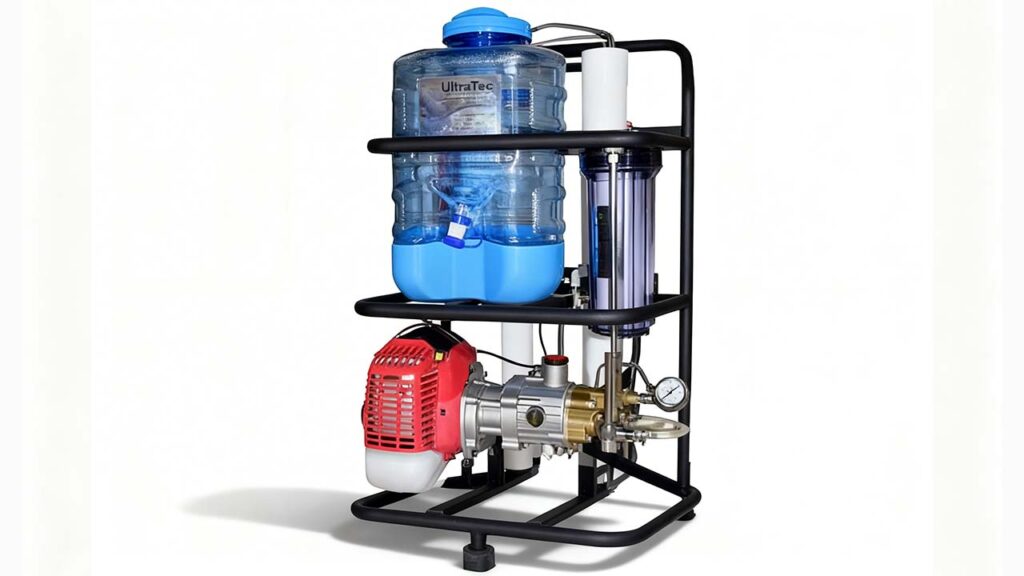
Key Technical Specifications
| Specification | UltraTec Portable Sea Water RO System |
| Desalination Technology | Reverse Osmosis (RO) |
| Dimensions | 400 × 470 × 760 mm |
| Weight | 36 kg |
| Motor | 2 HP |
| Power Source | Gasoline Engine |
| Fuel/Oil Specification | 2T Engine Oil (25:1) |
| Pressure Monitoring | Operating Pressure Gauge |
| Membrane Housing | FRP-2521-1000P |
| Feed Connection | 1/2 inch |
| Freshwater Outlet | 3/8 inch |
The system uses reverse osmosis membrane filtration to separate dissolved salts and other impurities from seawater. Its portable configuration is especially relevant for operations where freshwater production is needed without relying on shore-based infrastructure.
However, operators should confirm the system’s rated freshwater output, fuel consumption, feedwater requirements, and suitability for the intended operating environment before selecting a unit.
Water Makers for Larger Boats and Yachts
For vessels requiring a permanently installed system or greater daily freshwater production, UltraTec also supplies Sea Recovery Water Makers.
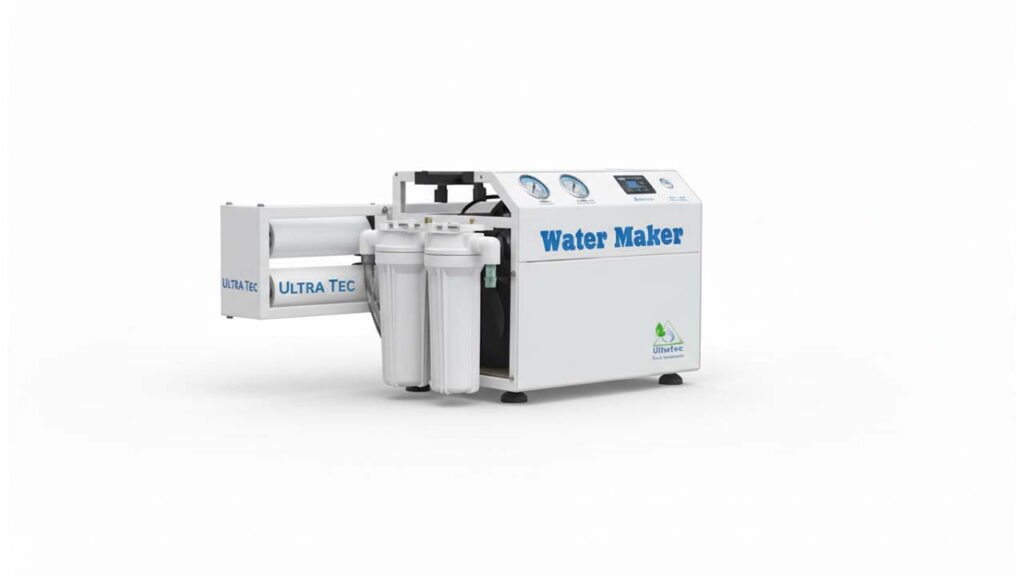
The available range includes compact 12V/24V DC water makers for smaller boats, AC-powered systems for larger yachts, and high-capacity desalination equipment for commercial marine applications.
Some models offer automatic pressure adjustment, freshwater flushing, and compact modular configurations to accommodate restricted installation spaces.
Choosing Between Portable and Installed Systems
A portable gasoline-powered unit may suit temporary operations and remote sites without dependable electricity. A battery-powered marine water maker is generally more suitable for smaller vessels with DC electrical systems, while larger yachts and commercial vessels may benefit from higher-capacity installations.
The most appropriate solution depends on how much freshwater is required each day, how many hours the unit can operate, and whether sufficient space and power are available.
By evaluating these factors before installation, vessel operators can select a water maker that provides dependable freshwater production without unnecessary energy consumption or oversized equipment.
Where Portable Desalinators Are Used
The water maker made for yachts or boats eliminates the necessity of scheduling your journeys exclusively for refilling purposes. Workboats and fishing vessels receive water for both drinking and cooking and washing purposes through this system. Expensive deliveries of water to offshore platforms and survey ships and remote camps find replacement in this product. When localwater sources become hazardous or damaged emergency teams alongside coastal projects depend on mobile units.
How Much Water Do You Actually Need?
Most people don’t size it correctly. First calculate the daily use, and then choose a unit that can cover that with a few hours of run.
| Vessel / Site | Crew or People | Daily Need (Approx.) |
| Small sailboat | 2 | 40 to 80 L |
| Cruising yacht | 4 to 6 | 200 to 400 L |
| Fishing boat | 6 to 10 | 300 to 600 L |
| Offshore crew camp | 20 or more | 2,000 L and above |
Energy Use and Efficiency
Power consumption shows the highest demand in the form of the high pressure pump. Small non-recovery units drain large quantities of energy for each litre they produce. Many larger systems incorporate an energy recovery device which recycles pressure from the brine stream and significantly reduces power consumption. A boat which runs on battery power combined with solar panels needs this difference to determine water maker feasibility.
Keeping a Water Maker in Good Condition
Maintenance failures cause most faults in equipment, not equipment faults themselves. Standing units require maintenance because seawater deposits salt and marine growth during its operation.
| Problem | Common Cause | What to Do |
| Low output | Clogged pre-filter | Replace the filter element |
| Salty product water | Fouled or damaged membrane | Clean or replace the membrane |
| Bad smell or taste | Bacterial growth during storage | Flush and preserve the system |
| Pressure drops | Air in the line or a worn pump | Check fittings and pump seals |
A few habits make a big difference:
- After using the system, dump it with fresh water.
- In case the system stays inactive for one or two weeks you need to use a preservative.
- The unit should not be used in ports because that place has oil and sewage in the water.
- Schedule your filter replacements because you should not depend on output decrease.
What to Check Before You Choose One
Assess your daily liquid intake together with present energy output and installation room for your solar system. The choice depends on minimum power units needed for battery-powered boats and so does a remote area without electricity need an engine-based unit. Hold a prior assessment on the availability of filters and membranes because an extended journey will face unit inoperability when such essential components become unavailable.
Final Thoughts
A portable water maker gives boats, yachts and offshore teams freedom from dock water and delivery schedules. The right unit depends on your daily use, your power source and how well you can maintain it. If you are weighing options, Ultratec LLC can help you work out the size and type that suits your vessel or site. You can also look at our Sea Recovery water maker for larger marine setups.