
White scale on your kettle, spots on glass, soap that won’t lather: these usually point to hard water. A salt-based water softener fixes this, but only if it has the right salt. Tablets are the most common choice, and this guide explains what they are, how they work, and how to choose them.
What Are Water Softener Salt Tablets?
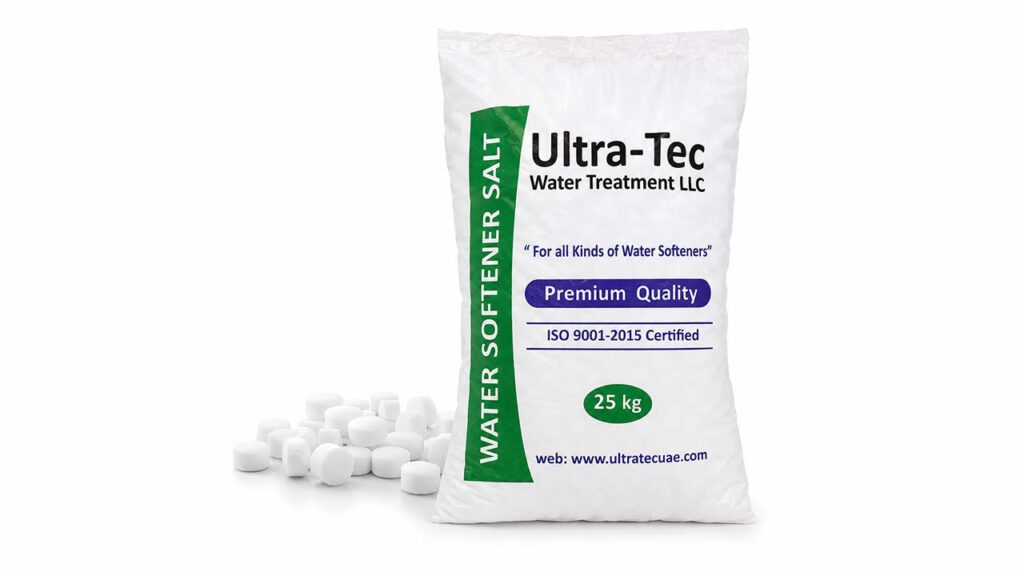
Water softener tablets are small pressed blocks of sodium chloride, usually made from evaporated or solar salt. You may also hear them called tablet salt or salt balls for water softener units. They go into the brine tank of your softener. They are not table salt and are not meant for food.
How Salt Works Inside a Softener
Salt does not soften water directly. The softener holds resin beads that trap calcium and magnesium, the minerals that cause hardness. Once the beads are full, the unit cleans them with a strong salt solution. This is called regeneration, and it is the same principle in home units and in industrial ion exchange softeners.
| Stage | What Happens |
| Service | Hard water passes through resin and comes out soft |
| Brine draw | Salty water from the tank is pulled into the resin |
| Slow rinse | Brine pushes the trapped minerals off the beads |
| Fast rinse | Fresh water flushes out the leftover brine |
| Tank refill | Water goes back into the tank to make new brine |
Types of Softener Salt
| Salt Type | Purity (Approx.) | Cost | Best For |
| Salt tablets | 99%+ | Medium | Homes, offices, small commercial units |
| Evaporated pellets | 99.9% | Higher | Units that need very clean brine |
| Solar crystals | 99%+ | Lower | Larger tanks with regular cleaning |
| Rock salt | 98 to 99% | Lowest | Big industrial systems |
How to Choose the Best Water Softener Salt Tablets
| What to Check | Why It Matters |
| Purity on the bag | Higher purity means less sludge in the tank |
| “For water softeners” label | Table salt and pool salt are not the same |
| Additives | Iron-remover salt only helps if your water has iron |
| Bag size | Heavy bags are hard to lift into a tank |
| Manufacturer’s advice | Some units have salt type limits |
Common Problems and Fixes
| Problem | Likely Cause | Fix |
| Salt bridge (hard crust, water still hard) | Humidity or low-grade salt | Break the crust with a broom handle and refill with tablets |
| Mushing (sludge at the bottom) | Fine impurities in the salt | Clean the tank and change salt |
| Water still hard | Empty tank or worn resin | Refill salt and check valve settings |
| Brown stains | Iron in the water | Add a pre-filter or iron-remover salt |
How Much Water Softener Salt Do You Need?
There is no fixed monthly quantity for every softener.
Salt consumption mainly depends on:
- Incoming water hardness.
- Daily water consumption.
- Resin capacity and softener size.
- Salt dosage during regeneration.
- Regeneration frequency.
A villa with moderate water use may consume considerably less salt than a hotel or commercial laundry. Check the brine tank regularly rather than waiting until the salt runs out.
For larger facilities, keeping a record of monthly salt consumption can also help identify unusual changes in system performance.
Where to Get Water Softener Salt in the UAE
Once you know what to look for, the next question is where to buy. Ultra Tec Water Treatment LLC supplies water softener salt for home units, offices, and commercial systems, so you can pick up the right salt along with your softener filters and parts. If you are not sure which type your unit needs, send us the model or a photo of the brine tank, and we will tell you what fits.
Salt is only one part of a softener setup. If your system is old or struggling with very hard water, you can also look at our water softener systems before deciding to just keep refilling salt.
Final Thoughts
Good salt keeps a softener working properly and protects pipes, heaters, and appliances from scale. If you are not sure which salt suits your unit, or whether your water needs a softener at all, the team at Ultra Tec Water Treatment LLC can look at your setup and advise you.